
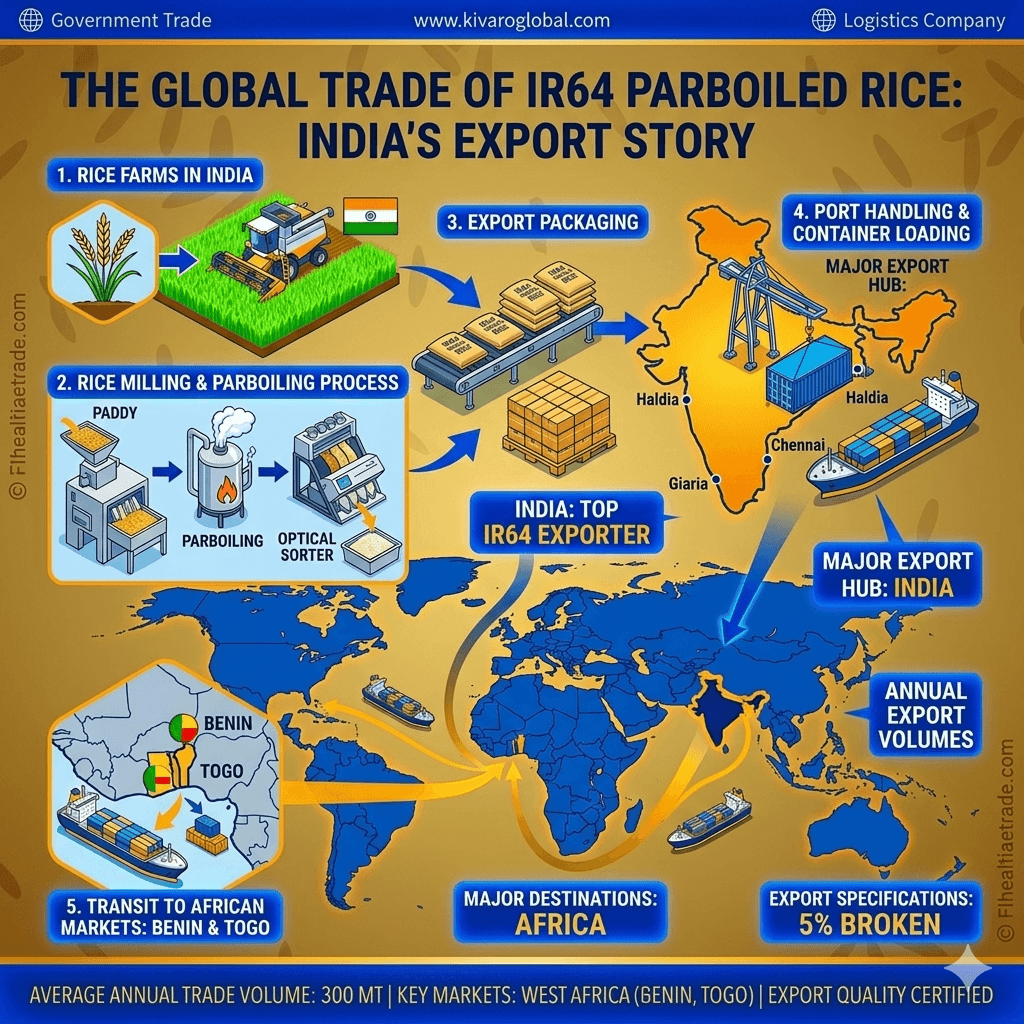
In the global rice trade, only a few varieties achieve large scale international demand. Among them, IR64 parboiled rice has emerged as one of the most widely exported non basmati rice varieties from India.
Across markets in West Africa, Asia, and parts of the Middle East, importers consistently rely on this variety because it provides the right balance of price, availability, and stable supply.
Unlike premium rice varieties that target niche markets, IR64 serves high consumption regions where affordability and consistent availability are critical.
For buyers exploring the global rice trade, understanding why IR64 dominates exports helps explain how staple food supply chains operate across developing markets.
Large Scale Production in India
One of the strongest advantages of IR64 rice is the scale at which it is cultivated in India.
This variety is widely grown in rice producing states such as
Chhattisgarh
Andhra Pradesh
Maharashtra
Because of its adaptability and high yield, farmers cultivate IR64 across large areas. This allows exporters to access substantial volumes of rice required for international shipments.
Large production capacity is essential for export markets where buyers often purchase full container loads on a regular basis.
If you want to understand the characteristics of this variety in detail, you can read our guide here
What is IR64 Parboiled Rice and why global buyers prefer it
Multi Crop Production Ensures Year Round Supply
Another major reason behind IR64’s export dominance is multi crop cultivation.
In several rice growing regions of India, farmers can produce IR64 multiple times within a year depending on irrigation availability and climate conditions.
This means exporters are not restricted to a single harvest cycle.
Year round availability allows exporters to supply international buyers consistently without major seasonal shortages. This supply stability is one of the key reasons why importers rely heavily on IR64 shipments.
Price Advantage in High Consumption Markets
For many importing regions, rice is a staple food consumed daily by millions of people. Because of this, price sensitivity plays a major role in purchasing decisions.
African buyers often prefer IR64 rice primarily because of its competitive pricing and consistent availability.
Compared with premium varieties such as basmati or jasmine rice, IR64 offers a more affordable option while still maintaining acceptable cooking quality for large scale consumption.
In markets where traders distribute rice to large populations, affordability becomes one of the most important factors influencing import decisions.
You can also understand how exporters negotiate rice prices with mills in our guide here
How to negotiate rice prices with millers for export business in India
Competition from Other Rice Exporting Countries
Although India dominates the IR64 export segment, international rice trade remains highly competitive.
Exporters often compete with rice shipments from countries such as
Vietnam
Thailand
Pakistan
Each of these countries exports rice varieties that target similar markets. Vietnamese and Thai rice shipments often compete in price sensitive regions, while Pakistani rice varieties also supply African markets.
Despite this competition, Indian IR64 rice remains attractive to importers because of its consistent supply and large scale production capacity.
Strong Demand in West African Trade Hubs
West Africa is one of the largest markets for Indian parboiled rice.
Countries such as Benin and Togo function as major trade hubs for rice distribution across the region. Once shipments arrive at these ports, traders from neighboring countries travel there to purchase rice in bulk and transport it to inland markets.
Because these hubs serve multiple countries, the demand for affordable rice varieties like IR64 remains extremely strong.
You can read a detailed market analysis in our guide
IR64 Non Basmati Rice exports from India to West Africa
Packaging and Market Preferences
Packaging also plays an important role in rice trade.
In many African markets, rice is typically packed in fifty kilogram bags which makes it easier for traders to transport and distribute in wholesale markets.
Importers often prefer suppliers who can provide consistent packaging, custom labeling, and reliable bag quality because these factors influence how the product is sold locally.
When combined with competitive pricing, proper packaging helps importers distribute rice efficiently across regional markets.
Quality Verification Before Shipment
Because rice exports operate on large volumes and thin margins, maintaining quality consistency is critical for exporters and importers.
This is why many shipments undergo independent quality inspection before containers are loaded.
Inspection agencies verify parameters such as moisture level, broken percentage, and grain quality to ensure the shipment matches the agreed specifications.
You can read more about this process here
Third Party Inspection in IR64 Rice Exports Buyer Quality Guide
The Role of Reliable Exporters
Managing the export of IR64 rice requires coordination between rice mills, logistics providers, inspection agencies, and international buyers.
Exporters who understand procurement networks across different regions can maintain consistent supply even when market demand fluctuates.
Companies such as Kivaro Global work with multiple millers and suppliers across India to ensure buyers receive consistent shipments that meet export quality standards.
For importers looking to build a reliable supply chain, working with experienced exporters can reduce many of the operational risks associated with international rice trade.
Final Thoughts
IR64 parboiled rice has become one of the most important staples in the international rice trade. Its affordability, year round availability, and suitability for large scale consumption markets make it the preferred choice for many importers.
As global demand for staple foods continues to grow, the role of Indian IR64 rice in feeding large populations across Africa and other regions is likely to remain significant for years to come.