
A Merchant Exporter’s Practical Cost Breakdown from India
When importing IR64 Parboiled Rice from India, one of the most common questions buyers ask is:
Why does the price fluctuate so often?
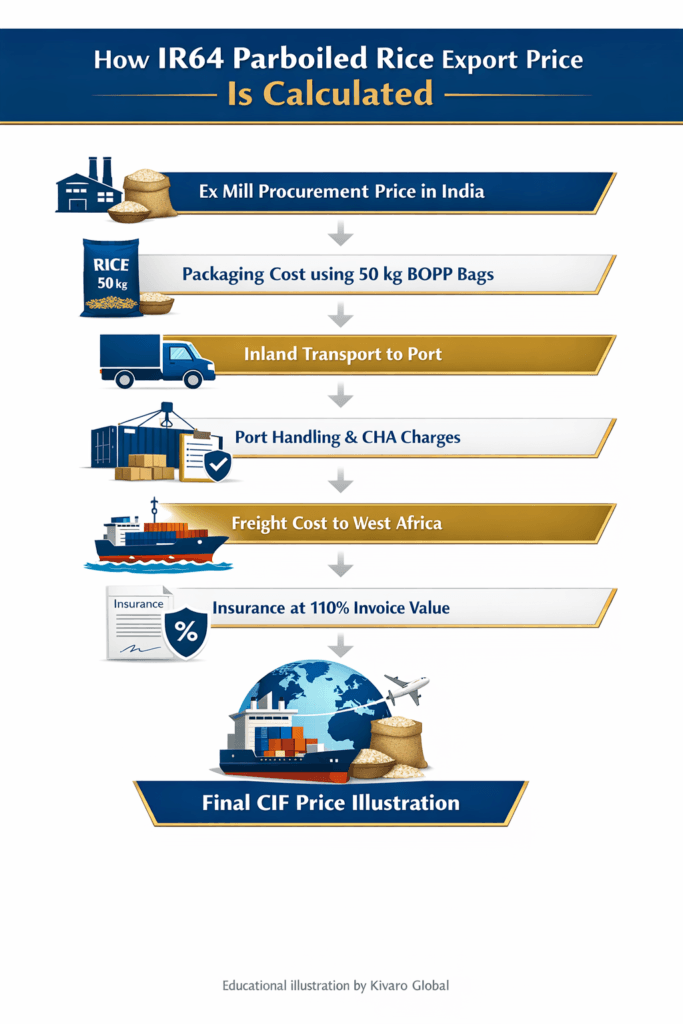
The answer lies in understanding the full cost chain — from ex-mill procurement to final CIF delivery at destination port.
If you are new to this segment, first read our detailed explanation of
👉 IR64 Parboiled Rice from India and why global buyers prefer it
This article focuses specifically on how export pricing is structured.
Step 1: Ex-Mill Procurement Price
Merchant exporters generally prefer buying on a loose ex-mill basis to maintain control over packaging and logistics.
Recent ex-mill prices:
• Chhattisgarh: ₹29.50 per kg
• Gondia (Maharashtra): ₹29.70 per kg
• Kakinada (Andhra Pradesh): ₹31.00 per kg
Prices vary by region and availability. Just last month, rates were above ₹30 per kg across most sourcing belts.
Mills typically block price for 1–2 weeks unless a major government policy or supply shock occurs.
When policy changes, mills increase prices overnight.
To understand sourcing strategy better, read our guide on
👉 how to negotiate rice prices with millers for export business in India
Step 2: Parboiled vs Raw Price Difference
IR64 Parboiled Rice is generally around ₹1 per kg higher than raw IR64 because of:
• Steaming process
• Mechanical drying
• Energy cost
• Lower breakage percentage
Always confirm the rice is Sortex clean, not just fan clean.
Quality difference directly impacts price and buyer acceptance.
For technical understanding, read
👉 how moisture and broken percentage decide the real price of IR64 rice exports from India
Step 3: Packaging Cost
For African markets, the standard is:
• 50 kg BOPP printed bags
Approximate bag cost:
₹25 + GST
Per metric ton (20 bags):
₹500 + GST approx.
Exporters usually supply custom-branded bags to mills for printing.
Step 4: Inland Transportation
Logistics significantly affects final pricing.
Approximate transport cost per kg:
• Chhattisgarh → Mundra/JNPT: ₹3 – ₹3.5
• Chhattisgarh → Vizag (bulk via ICD): ₹2 – ₹2.5
• Gondia → JNPT: ₹2.5 – ₹3
Port selection depends on cargo size and vessel availability.
• West coast ports are often practical for startup shipments
• East coast may be viable for large volume bulk
Step 5: Port & Export Handling Charges
Average export handling cost:
₹35,000 – ₹40,000 per container
This includes:
• CHA charges
• VGM
• Phytosanitary certificate
• THC
• Seal charges
At 25 MT per container, this equals approximately:
₹1,400 – ₹1,600 per MT
Always request total freight quotation including all charges to avoid hidden last-minute costs.
If you are new to documentation, review
👉 how to import IR64 rice from India – step by step guide for international buyers
Step 6: Freight Component
Freight rates fluctuate based on global demand and container availability.
Current freight range to West Africa:
• $1000 – $1200 per 20 ft container (West Coast)
• $1300 – $1600 (East Coast)
At 25 MT load:
Approximately $40 – $48 per MT from West Coast.
Freight can represent nearly 15% of CIF price in stable market conditions.
A freight spike can immediately reduce competitiveness.
Step 7: Sample CIF Calculation (Illustrative)
Let us assume procurement from Chhattisgarh:
Ex-Mill: ₹29.50/kg
Logistics: ₹3.25/kg
Packaging: ₹0.50/kg
Port Handling: ₹1.50/kg
Total before margin (FOB base):
₹34.75/kg
Convert at ₹90.90/USD:
₹34.75 ÷ 90.90 ≈ $0.38/kg
= $380 per MT FOB (approx)
Add freight ($45 per MT average):
CIF ≈ $425 per MT
Add insurance (110% invoice value standard practice):
Final CIF may land around:
$430 – $435 per MT depending on minor cost variations.
This is a simplified illustration. Actual price varies by region, timing, and freight negotiation.
Step 8: Margin Reality in IR64 Trade
Non-basmati rice export is a volume-driven, capital-intensive business.
Typical net margin:
3% – 5%
This is not a high-margin commodity. Stability and supplier reliability determine long-term success.
For broader market perspective, read
👉 IR64 non basmati rice exports from India to West Africa – complete buyer guide
Step 9: FOB vs CIF Strategy
New exporters often prefer FOB to reduce freight risk.
Established buyers often work on CIF for better control.
Payment structure:
• TT is most common
• LC is rare for trial orders due to cost
• Buyers offering strong advance often negotiate aggressively
Understanding payment risk is part of pricing strategy.
Step 10: Policy & Global Competition Impact
Government policy has immediate effect on pricing.
Recent examples include:
• Export duty on non-basmati rice
• Minimum Export Price (MEP) of $460 per MT
• Later removal of restrictions
India also competes with Vietnam, Thailand, and Pakistan.
When policy changes, mills revise price immediately.
Final Conclusion
The export price of IR64 Parboiled Rice from India is not random.
It is a structured combination of:
Procurement + Packaging + Logistics + Port Charges + Freight + Policy + Margin
Serious buyers understand cost layers.
In IR64 trade, consistency matters more than chasing lowest price.
At Kivaro Global pricing transparency and supplier discipline are central to long-term export partnerships.
- How Freight and Logistics Affect IR64 Rice Export Prices from India
- Why IR64 Parboiled Rice Dominates Global Non Basmati Rice Exports
- Third Party Inspection in IR64 Rice Exports | Buyer Quality Guide
- Where Should You Export IR64 Parboiled Rice in 2026?
- How IR64 Parboiled Rice Export Price Is Calculated from Mill to CIF