
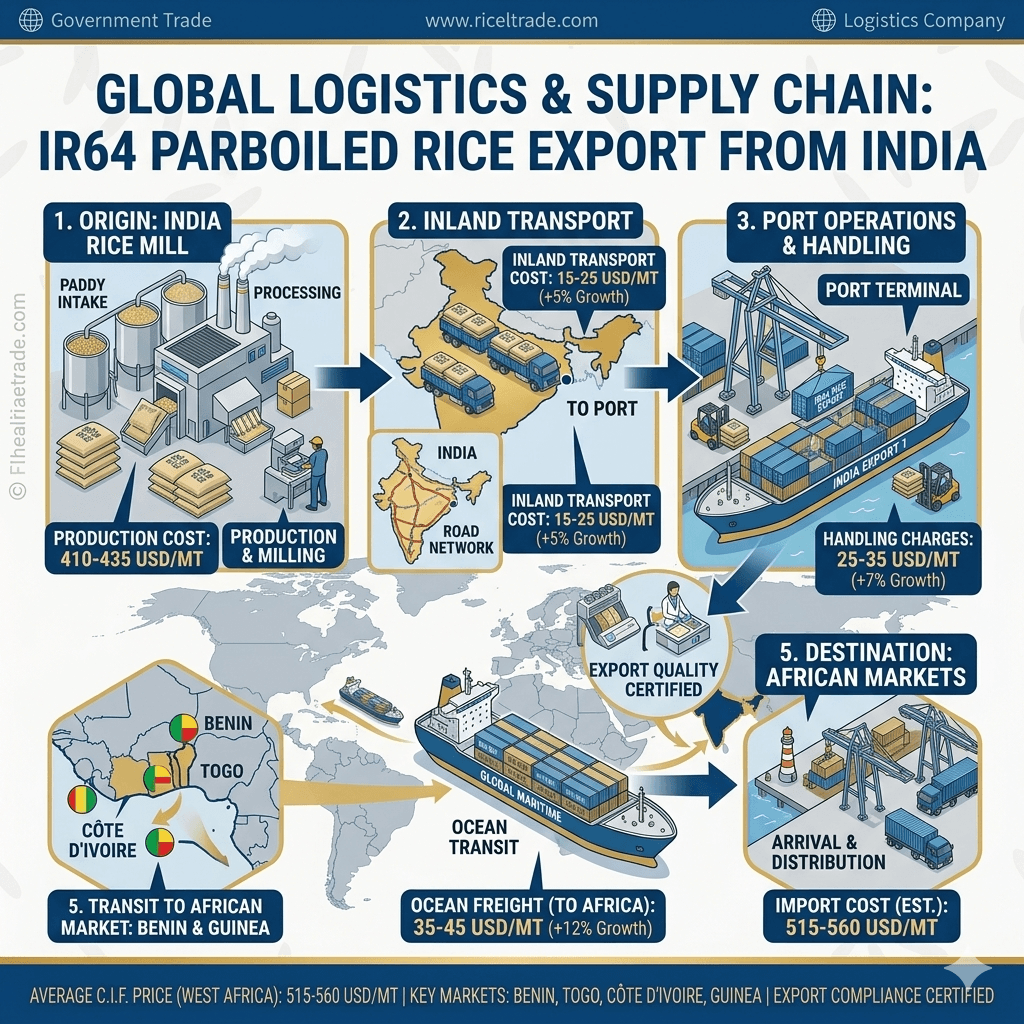
In the rice export business, many new traders focus only on the price quoted by rice mills. However, experienced exporters know that the final export price depends heavily on logistics and freight costs.
For commodities such as IR64 parboiled rice, margins are often very thin. Even small changes in transport or shipping costs can significantly affect the competitiveness of an exporter in international markets.
Understanding how logistics work from rice mill to destination port is essential for anyone planning to export rice from India.
From Rice Mill to Export Port
Most exporters procure IR64 rice from major rice producing regions such as
Chhattisgarh
Gondia in Maharashtra
Kakinada region in Andhra Pradesh
After procurement, the rice must be transported from the mill to the export port.
Transport cost depends largely on distance and infrastructure.
Typical inland transport costs may range around
3 to 3.5 rupees per kilogram when transporting rice from Chhattisgarh to western ports such as Mundra or JNPT.
For exporters sourcing rice from Andhra Pradesh and shipping through ports such as Visakhapatnam, logistics costs may be slightly lower because of shorter transport distances.
In many cases the mill price includes loading of rice onto trucks, but unloading and further handling costs are usually separate
Choosing the Right Export Port
Port selection plays an important role in determining the final export cost.
Indian rice exporters typically use ports such as
Mundra
JNPT
Visakhapatnam
Kakinada
West coast ports like Mundra and JNPT are commonly used by exporters serving African markets, especially when shipments are containerized.
However, for very large shipments or bulk cargo, exporters may sometimes use eastern ports depending on vessel availability.
Freight costs can vary significantly depending on the port and shipping line schedules.
Container Handling and Port Charges
Apart from inland transport and ocean freight, exporters must also consider several operational costs at the port.
Typical container related charges may include
Customs clearance
CHA charges
VGM certification
Terminal handling charges
Container seal charges
Phytosanitary documentation
Combined port and documentation costs can reach around thirty five thousand to forty thousand rupees per container depending on the port and service providers involved.
These operational expenses must always be included when calculating the final export price.
Ocean Freight to West African Markets
Shipping costs are another major component in rice export pricing.
Freight rates fluctuate based on global shipping demand, container availability, and seasonal cargo volumes.
For container shipments from the west coast of India to West African ports, typical freight rates may range around
1000 to 1200 US dollars per container under normal market conditions.
For shipments departing from eastern ports, freight costs may sometimes increase to around
1300 to 1600 US dollars per container depending on the shipping route and container availability.
Because rice is a bulk commodity, these freight variations can strongly influence the final CIF price offered to buyers.
Container Capacity and Shipment Planning
Rice exporters usually ship IR64 rice in standard containers.
A typical twenty foot container generally carries around twenty five metric tons of rice packed in fifty kilogram bags.
Shipment planning becomes very important when handling large export orders. Exporters often coordinate with multiple mills and suppliers to ensure sufficient stock is available for container loading.
Delays in vessel schedules or container shortages can disrupt shipment timelines, which is why logistics planning plays such a crucial role in rice exports.
Why Freight Can Change Market Competitiveness
Rice trade operates on high volumes and relatively small profit margins.
In many cases, exporters operate with margins of only three to five percent.
This means that unexpected increases in freight or logistics costs can quickly eliminate profitability or make an exporter uncompetitive compared with suppliers from other countries.
Exporters often compete with rice shipments from
Vietnam
Thailand
Pakistan
Because these countries also serve similar markets, controlling logistics costs becomes a key factor in maintaining competitive pricing.
Quality Control and Shipment Coordination
While logistics determine the cost of delivery, maintaining consistent quality is equally important.
Exporters usually ensure that shipments meet buyer specifications before containers are loaded.
Inspection agencies often verify moisture levels, broken percentage, and grain quality to avoid disputes after the shipment reaches the destination.
You can read about this process in detail here
Third Party Inspection in IR64 Rice Exports Buyer Quality Guide
Understanding quality parameters such as moisture and broken percentage is also important when negotiating export contracts.
A detailed explanation can be found here
How moisture and broken percentage decide the real price of IR64 rice exports from India
Building a Reliable Export Supply Chain
Managing rice exports successfully requires coordination between mills, transport providers, shipping lines, and inspection agencies.
Exporters who maintain strong relationships with suppliers across different regions can ensure consistent procurement and shipment schedules.
Companies such as Kivaro Global focus on coordinating procurement, inspection, and logistics to help international buyers receive reliable shipments of IR64 parboiled rice from India.
Final Thoughts
In rice exports, the price quoted by a mill is only the starting point. The final export price depends on several logistics factors including inland transport, port costs, container availability, and ocean freight.
For exporters and importers alike, understanding these logistics elements is essential for building a stable and competitive rice supply chain.
Careful planning of procurement locations, port selection, and shipping schedules can make the difference between a profitable shipment and a loss making transaction.